Materials
Unlike other projects, Word as Image can be made of just about anything. Your only real constraints are your personal budget, and whether or not it is a safety hazard. For example, the school typically frowns upon uncontrolled open flames, biohazards, strong acids or bases, illegal, radioactive, or other potentially dangerous materials.
A key concept for this project is materiality. While you could technically achieve a facsimile of LAWN with astroturf, it is neither as effective nor as interesting as a past student example in which the student sowed grass seeds in the shape of the letters L-A-W-N and let time, sun, and regular watering grow a living word. Its dynamic, changing nature made the word ephemeral, and by the end of the semester all the gaps had filled in completely, leaving only a small grassy patch. The letters themselves were made of grass and soil like a lawn, and they themselves comprised a lawn since the arrangement of multiple grasses in close proximity is generally understood to impart lawn-ness.
The idea of materiality as it relates to art is the principle that the substance or substances used to create artwork contributes to its meaning. So weapons made out of delft style ceramics such as this striking series by Helena Hauss have a very different meaning than a spiked bat made of wood and metal, or a forged iron great axe. Just as Anya Gallaccio's "Preserve Beauty" seriesLinks to an external site. would have a very different impact if she used fake flowers instead of real ones that can decay. When an artist takes into account the materiality of their work, they are not satisfied to merely make an image. An illusionistic representation can convey a great deal of meaning, but it does so in a very different manner than if the materials are also incorporated into the overall meaning of the work.
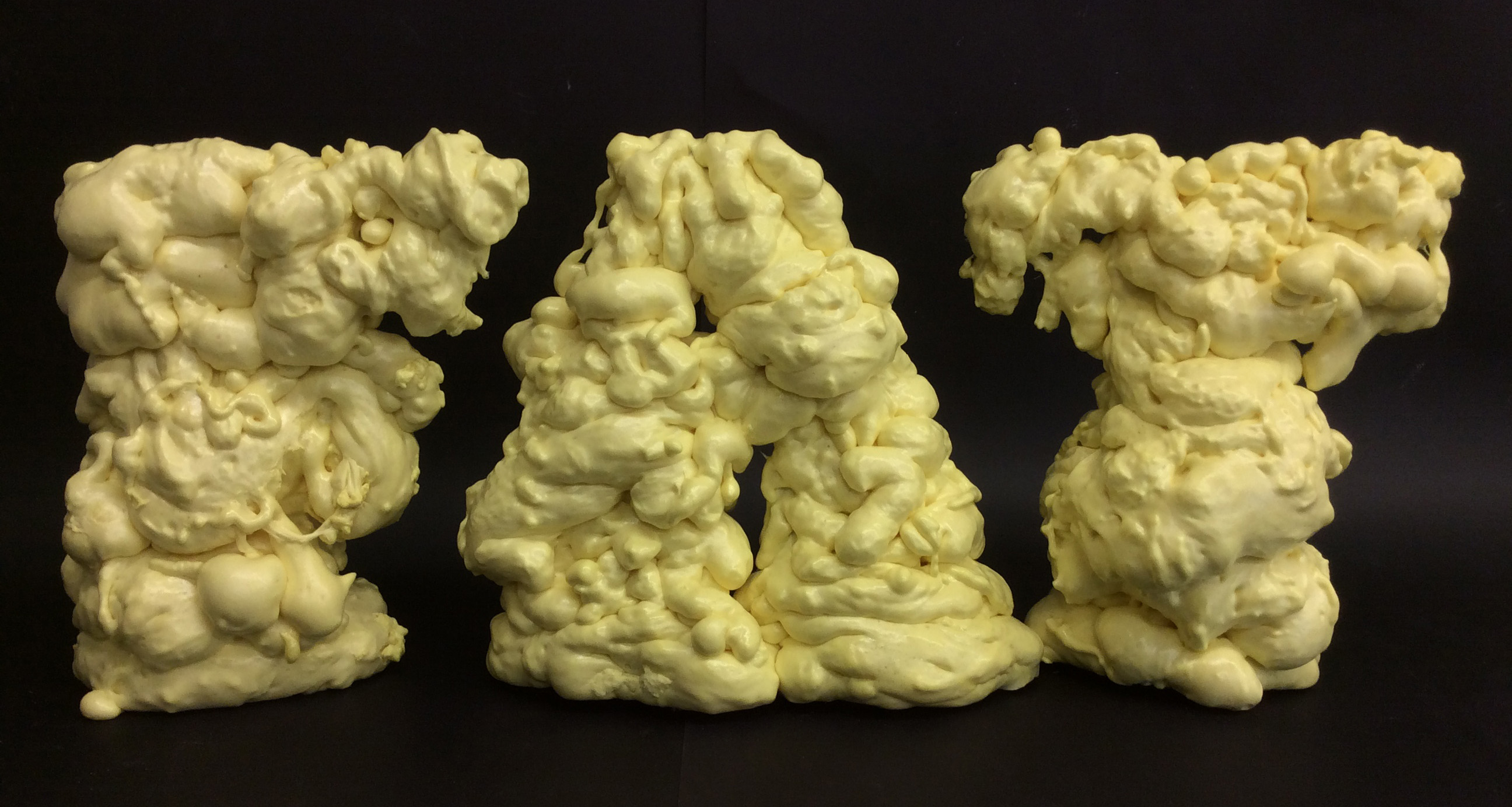
You are not forbidden from using materials that create a visual effect, but you should only do so when you have a compelling reason why not to make your word from a substance that contributes to its meaning. One student made the word FAT with expanded foam in order to avoid dealing with a large volume of actual fat. They were able to create a realistic image of unrendered fat without introducing an upsetting amount of raw animal tissue into the classroom. This falls under the category of avoiding a potential biohazard.
nother student used resin and aluminum honeycomb core to create the word HONEY. She learned a great deal about the materials and process of casting resin, but the end result was a bit lackluster compared to its potential. If she had instead used honey, beeswax, and real honeycomb, she could have made something really stunning. However, she prioritized permanence over materiality and made a perfectly serviceable image. This was a conscious decision on her part since she wanted a result she could keep. There is nothing inherently wrong with her choice, but the desired outcome was detrimental to conveying the full meaning of her word.
