Positive-Negative
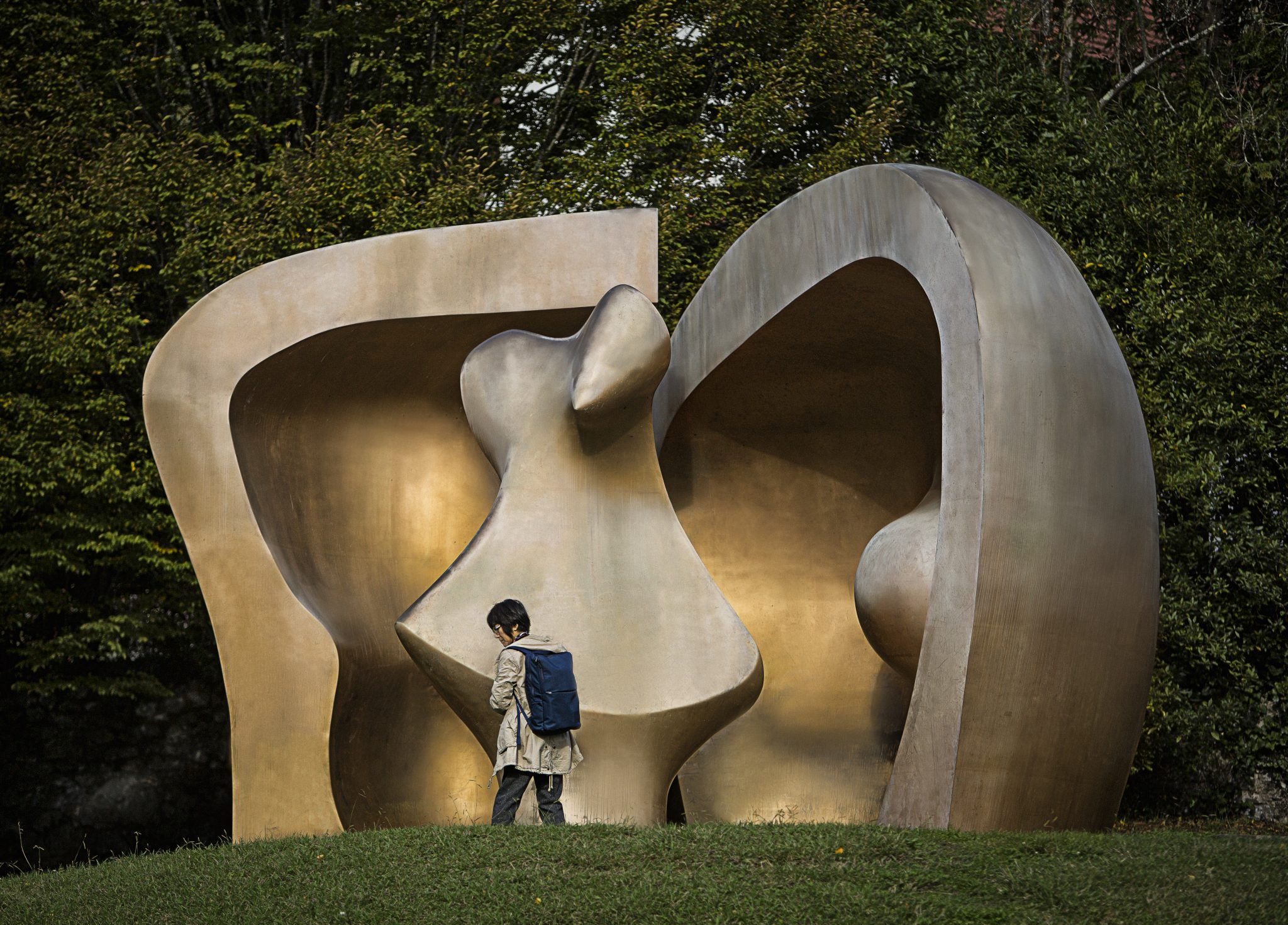
This project is meant to grow your visualization skills by creating abstract objects that contain both the positive and negative aspects of a form. Nature creates this dialog regularly. Shells and other casements for example - think walnut shell and its fruit - usually have surface features and volumes that were once mated and then become separated. The inside texture of one element relates to the outside texture of its complement. A roughly cracked and separated boulder can likewise contain this positive-negative relationship. Even continents have this jigsaw expression.
Your work is to be in the round, meaning it is to be seen - and is important - from all vantage points. It may be painted, stained, colored, or left natural as you see fit. The interaction of shadow and light is of extreme importance, as are surface texture and sheen.
There are two halves to this project:
-
Create two distinct objects that will be juxtaposed to one-another. Object A will be what you consider the positive aspect of a form, and object B will be its counterpart. They are to be composed as a pair of objects in such a way that a dialog is created between the two. For example, they may be placed close together so that the gap between them becomes very important. Or they may be placed in mirror relationships so that their positive and negative elements face away from one another. Any other compostiton that you feel brings out the power of their forms is viable.
-
From the results of your first piece, make a new one that incorporates aspects of the first - but as a single sculptural object. This object will contain positive and negative forms throughout that create internal dialogs using volume, texture, and mass. For example, picture an object where its protruding elements compliment its voids. These complimenting elements do not need to be literal; they can be implied. In this piece you can make as many of these juxtaposed elements as you wish; there can be two, or there can be 100. There needs to be a blance between the volume of the solid object and its negative space.
Subject Matter
This is an abstract project that does not have to relate to any kown form or object, but is not restricted in any way. You may decide to create forms that look like plants or animals, or simply intriguing organic or geometric forms.
Scale
Strive to make your forms fit a space of 10x10x12" to 12x12x12". This is not a strict dimension, and does not mean that you are making a cubic object. You are free to make any shape you want, where its outer boundries fit in the range of those dimensions.
Materials and Tools
You are to resource some items yourself and have them available for use in class the day following project introduction. Other materials will be provided for you.
You Supply:
- Raw cardboard
- Utility knife
- Petroleum jelly
- Packing tape or other strong tape
- Discarded or unwanted kitchen utensils that can be used to work freshly cast plaster such as knives, forks, spoons, potato peelers, cheese graters, etc.
- 1/2 to 1-gallon plastic bucket
- Media to affect color and sheen
- Grubby clothing that can be left in your cubby for the semester
We supply:
- Hot glue and hot glue guns
- Plaster
- Water
- PPE
- Sanding media
- Some tools for working plaster
Process
Before any construction or fabrication begins, spend time sketching out concepts, discussing these with Michael, Roger, Tony, and fellow students. We will supply paper.
Cardboard, hot glue, petroleum jelly, and tape are used to construct molds that are functionally able to flow and hold wet plaster long enough for the plaster to set and become rigid. The mold will then be stripped so that your casting becomes the object. With various tools, work the object until it is of satisfactory form. Working the cardboard is an indoor process, and casting with plaster is done outdoors.
Daily cleanup is a strict requirement.
Timeline
- Day 1 - Project introduction, sketching and conceptualizing
- Day 2 through 5 - Fabricate molds related to the first half of the project, cast and manipulate your two objects
- Day 6 - Group critique of your results, employ feedback to sketch out ideas, start your "second half of the project"
- Day 7 through 10 - Complete your mold, cast, manipulate, and finish your piece to your liking
- Day 11 - Group critique of final work, end of project
