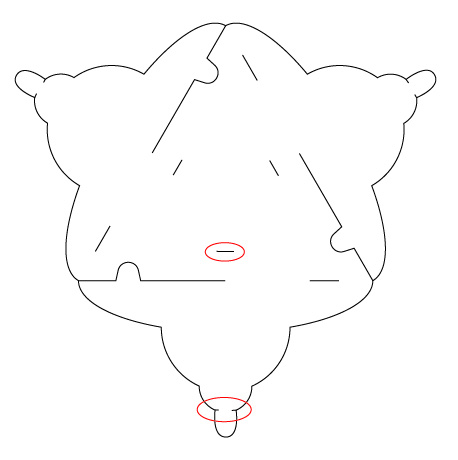
CIRCUMVOLUTION (a required design project)

Circumvolution means that an object curves or is bent in such a way that it doubles-back on itself; circumvolve. In this project, an extension is designed to connect somewhere beyond the standard interlock location. The extensions can reconnect with itself, or connect to another extension, or even connect back to one of the base polygon's faces. Any of these concepts create a complex volume of curved planes. The concept was invented by a student who realized she could tie extensions together in a way that added another layer of pattern to her lamp.
The design can be either dynamic or static becuase both can also be circumvolved.
Features of a circumvolved design:
- The extensions can either be static or dynamic.
- Elements of the extensions need to reconnect somewhere beyond the initial interlock.
- They can connect to themselves, to other extensions, or to the base polygon.
- The reconnection location can float above the base polygon if desired.
- The reconnection must be designed to lock strongly to its mating piece.
- The circumvolution must be refined and well thought-out.
- There can be added pieces that facilitate this new interconnection, which must visually and physically integrate into the design.
To design a circumvolved lamp, draw the base polygon. Create an extension, either static or dynamic, with at least one element that is long enough to be bent around to be reconnected. Design the reconnection interlock both on the end of the extension and the location where it is to reconnect. Repeat for all edges. The reconnection location can be wherever you desire, as long as it functions well without unwanted interference. It may connect to itself, an adjacent or other extension, or to either its own base polygon or another base polygon. It may even be integrated into the basic interlock if possible. The reconnection interlock must be strong and well made.

Circumvolved lamps can almost entirely obscure the base polyhedron. Because it has so many overlapping layers of material, the lamp may have a lot of complex light levels, and also have a reduction in overall brightness.