STATIC (a required design project)
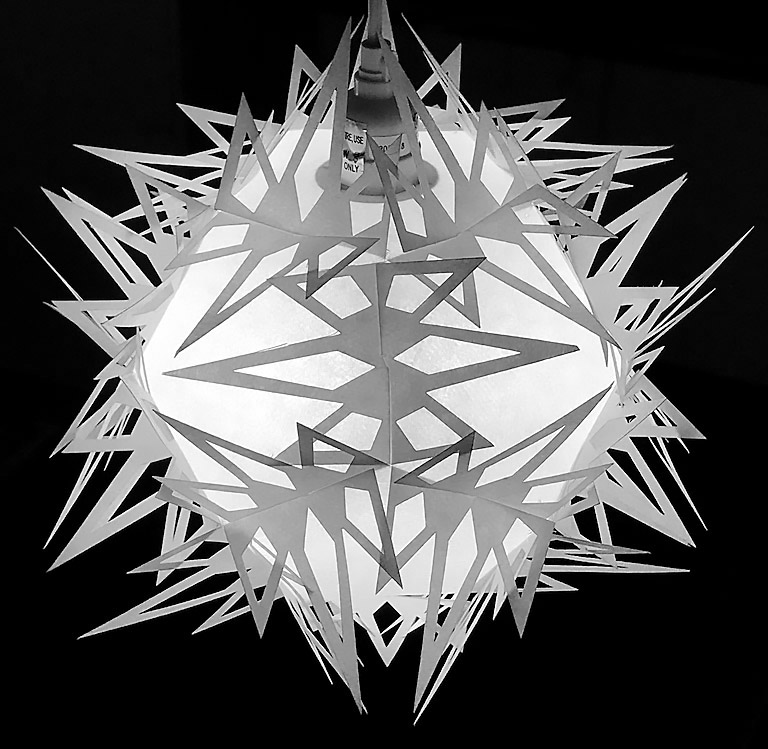
Static means that each extension is bilaterally symmetrical before it is mated to its counterpart. It is called "static" because the extensions do not evoke the feeling of rotational movement that "dynamic" designs do. Instead, the forms are balanced and at rest. Although the extensions do overlap and converge over each face of the polyhedron, this radiative appearance feels fixed in place.
Features of a static design:
- The module itself has dihedral symmetry, radiating from its center.
- Each extension has bilateral symmetry.
- Each mated pair of extensions has reflection symmetry about two axes.
- Although each mated pair has been rotationally oriented to one-another, this rotation is not noticeable. Instead, the pair look like mirror images about at least two axes.
To design a static module, draw the base polygon. At an edge, find the center point. Draw a perpendicular line out from the center point. About this perpendicular line, create a bilateral pattern. Repeat at each edge. The result will be a dihedral module.
Care must be taken to avoid extensions that collide with one-another in such a way that the parts cannot be assembled, or if they create an undesired overlap, or if the extensions edges are so closely aligned to adjacent extensions that imprecision makes the overall design look messy.

