DYNAMIC (a required design project)
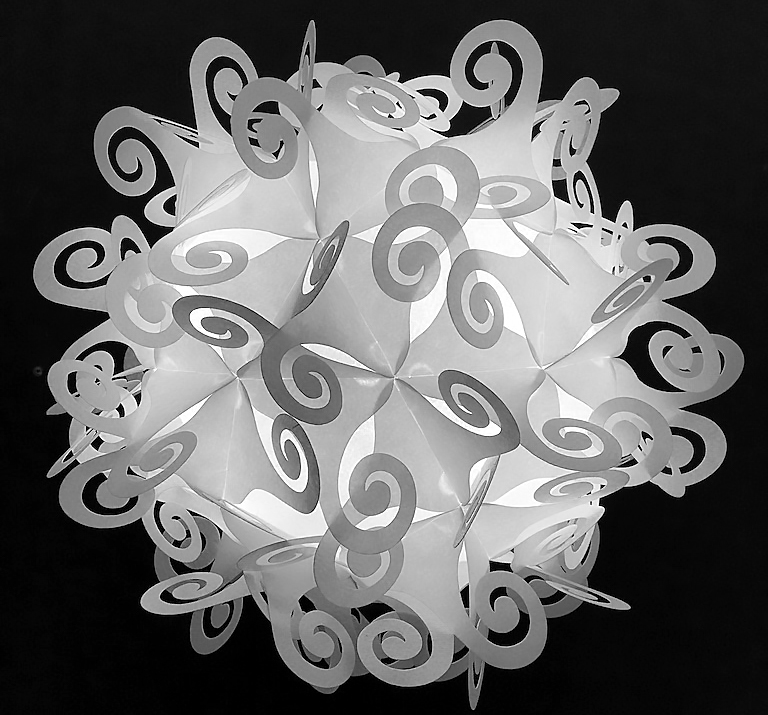
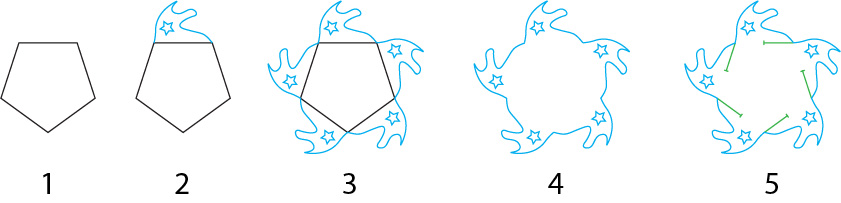
Dynamic means that each extension is asymmetrical along its central axis. It is called "dynamic" because the group of extensions feel like they rotate in the manner of a pinwheel. When taken as a whole, the extensions work in unison to create radial patterns, or chaotic relationships, breaking up the polygon's underlying static form.
Features of a dynamic design:
- The module itself has cyclical symmetry.
- Each extension is asymmetrical.
- Each mated pair of extensions has rotational and cyclical symmetry.
- To design a dynamic module, draw the base polygon. Draw an asymmetrical patten from one vertex to an adjacent one. Repeat around the polygon.
Care must be taken to avoid extensions that collide with one-another in such a way that the parts cannot be assembled, or if they create an undesired overlap, or if the extensions edges are so closely aligned to adjacent extensions that imprecision makes the overall design look messy.