Student Jewelry Examples
Anna Leah Bodo
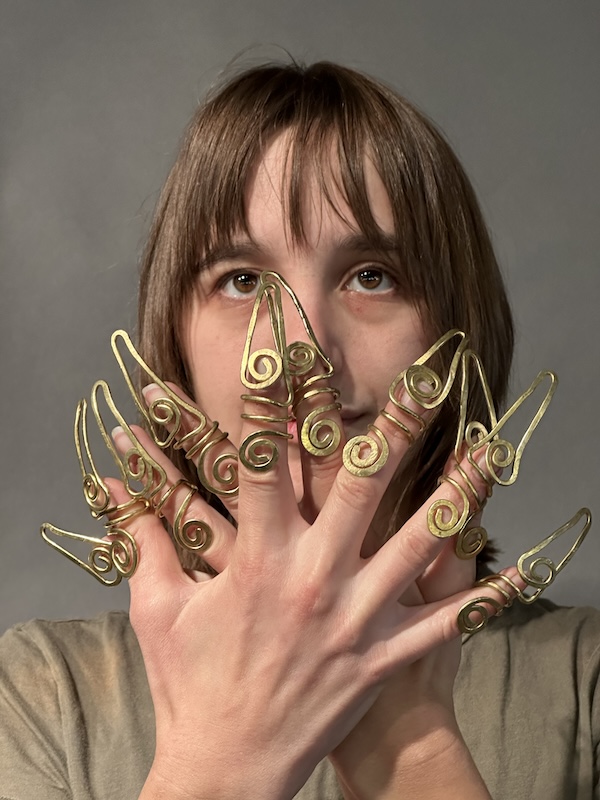
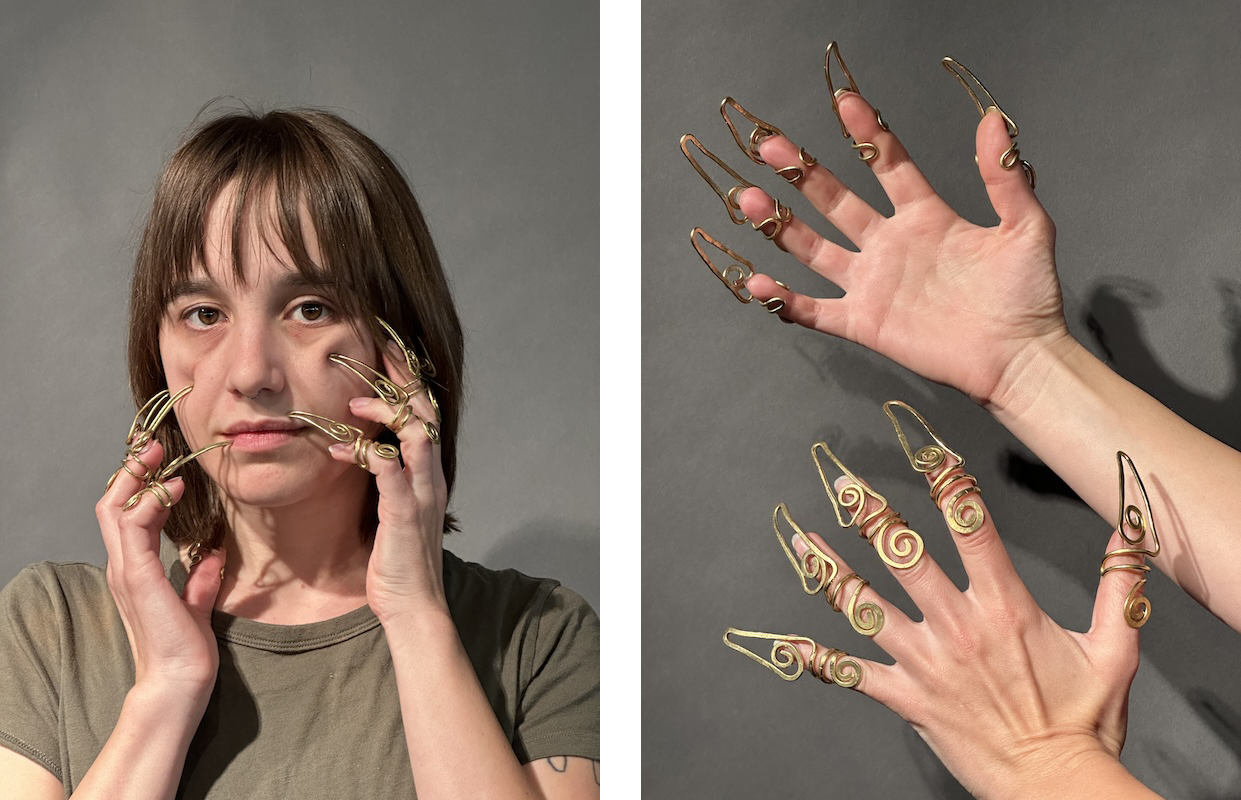
On this page are examples of jewelry - or more appropriately wearable art - made by students responding to the Calder Project. Some demonstrate similar motifs, media, and methods utilized by Calder, and others do not. It is important to define how work was done within and outside of the given scope and rules of the assignment. Above is the work of Anna Leigh Bodo, who used brass wire to create finger-worn pieces that are reminiscent of Calder, yet entirely unique. This is a creative solution to the project that both references its concepts, and explores a new avenue. Alexander Calder would not have created pieces that completely immobilized the wearer, but this feature makes Anna Leigh's project visually powerful. Reminiscent of Calder are the hammered spirals. Below are two more photos of this work.
Sophia Holt

Sophia Holt made small pairs of earrings that gave her time to create four sets. Some sets are fully hammered, while others use the raw brass wire almost directly off the spool. They borrow from Calder's meandering loops. Each set comprises two earrings that are mirror images of one-another. All four pairs share a common meandering and overlapping visual theme but each set explores a variation on that theme; different textures, changes to the loop pattern, and surface finish. Calder would have most certainly altered the entirety of the wire in his work. Sophia did manipulate much of the wire in her pieces, but left some parts untouched. All of them utilize store bought hypoallergenic piercings. These are looped through holes drilled in the brass. When piercing through skin, such as in the ears, it is wise to use the appropriate type of metal.

Amaya Lunibos Hartard

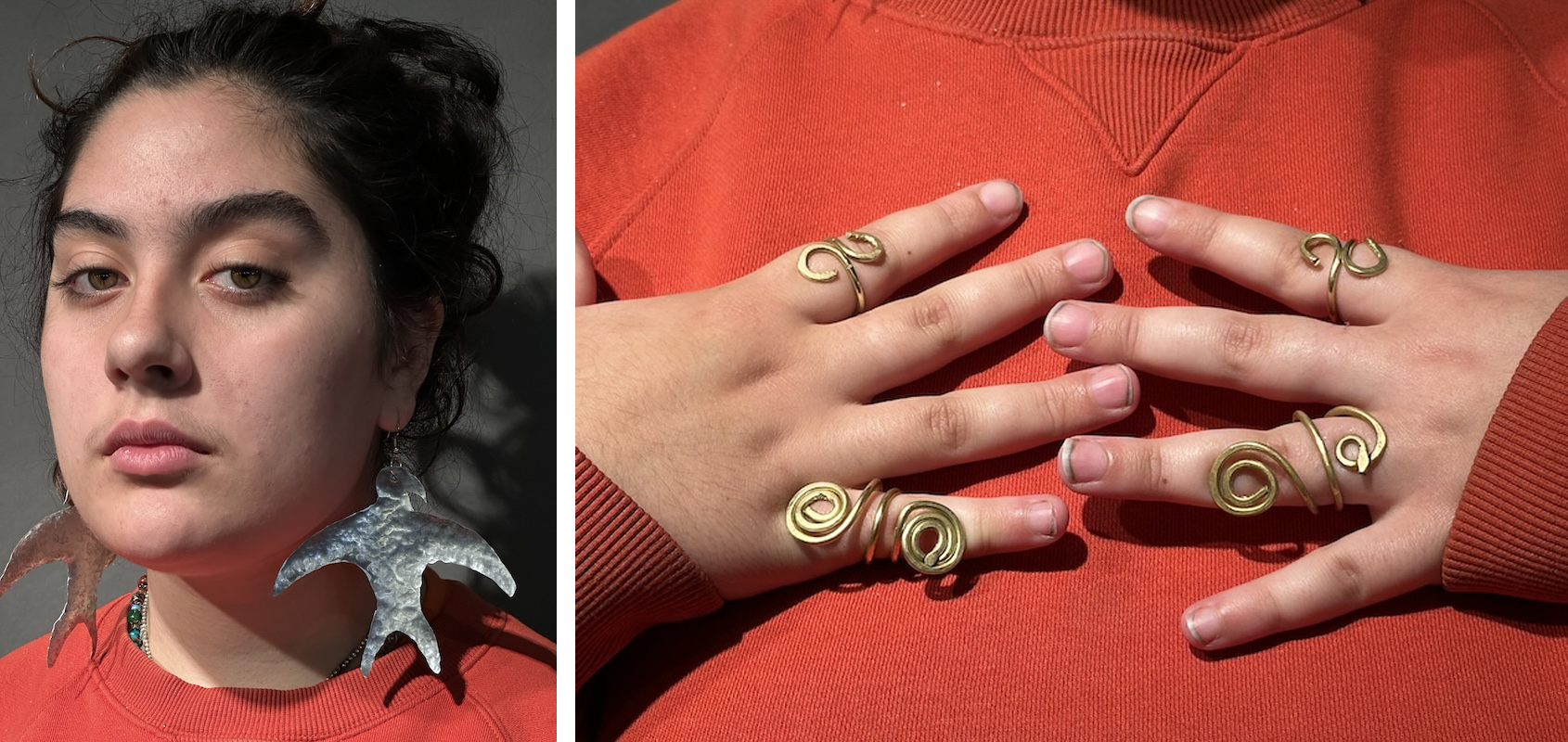
Above are pieces by Amaya Lounibos Hartard that incorporate lightweight aluminum sheet metal for the earrings - integrated with store-bought piercings - and hammered brass wire made into rings. The rings apply thematic elements similar to Calder, including the characteristic spirals. The large area of the earrings makes aluminum a good choice because they are very lightweight, Aluminum cannot be used for a piercing, as this material would adversely react with the body. Although the bird forms are not necessarily elements that Calder would have used in his jewelry, they certainly might be referenced in his early non-jewelry works. The bird forms are hammered into concavity through a technique of stretching and shrinking the metal. Stretching is thinning out the metal by hammering or compressing, and shrinking is thickening the metal by hammering in a specific way that reduces the length of the sheet's perimeter, and domes the metal.
Grace Moore

The earrings created by Grace Moore are a statement piece, that clearly shows how the body becomes a canvas for the work. Presented here against a dark background and sweater, they luminesce via reflection. These pieces are unusual for several reasons. First is that they are very large. Second, they are very heavy. Third, the galvanized components have relatively sharp edges, so care must be taken to avoid injury. Luckily, the wire elements are made from lightweight aluminum to offset the steel's weight. Certainly these works of wearable art could not be worn for long periods of time. The hand-wrought appearance is accentuated by the organic nature of the hand cut sheet's edges. Note that the spiraling wire forms are suspended in the middle of the holes, and held by one loop each. This allows the spirals to move loosely as in a mobile, so they can dynamically change their relationship to the framed space - as can be seen occurring in the left upper element. Galvanizing is a process of protecting steel from oxidation (rust) by zinc plating.
Weight-wise, aluminum is lightweight for a metal; it weighs about 168 pounds per cubic foot. Zinc weighs about 445 pounds per cubic foot. Steel weighs about 490 pounds, and brass is approximately 536 pounds for the same volume. If Grace's piece was made from brass of the same gauges as she used for the steel and aluminum, the earrings would be substantially heavier. On the other hand, they could have been made entirely from aluminum - except for the piercings - and been much lighter overall.
