Elaborations
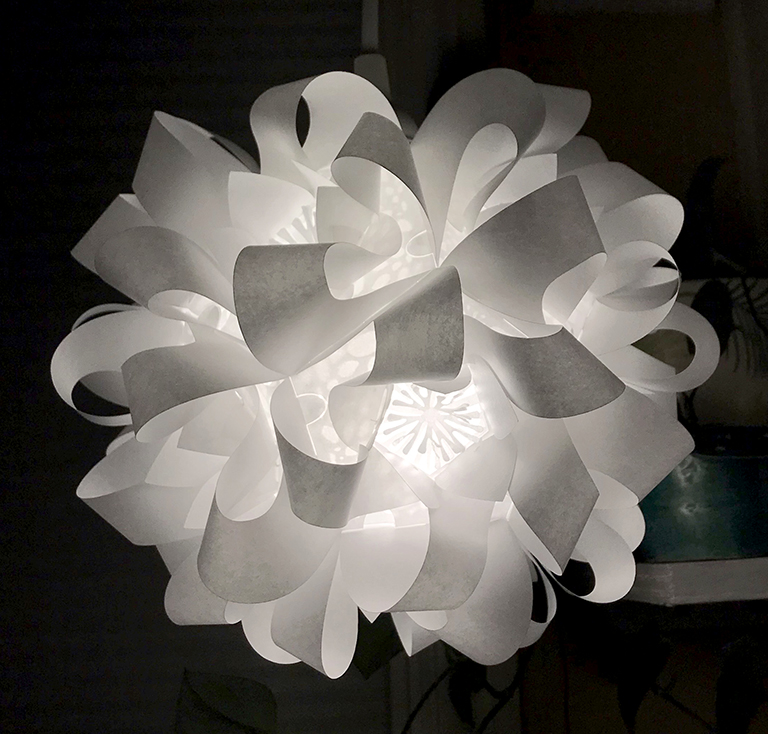
Some students like to elaborate on their designs and make the visual effect quite complex. While this is a wonderful idea in theory, it adds a lot of time and process to the project. If you can spare the effort then consider developing your design further by creating more involved extensions, perforations, and overlapping layers to project shadow onto the planes.
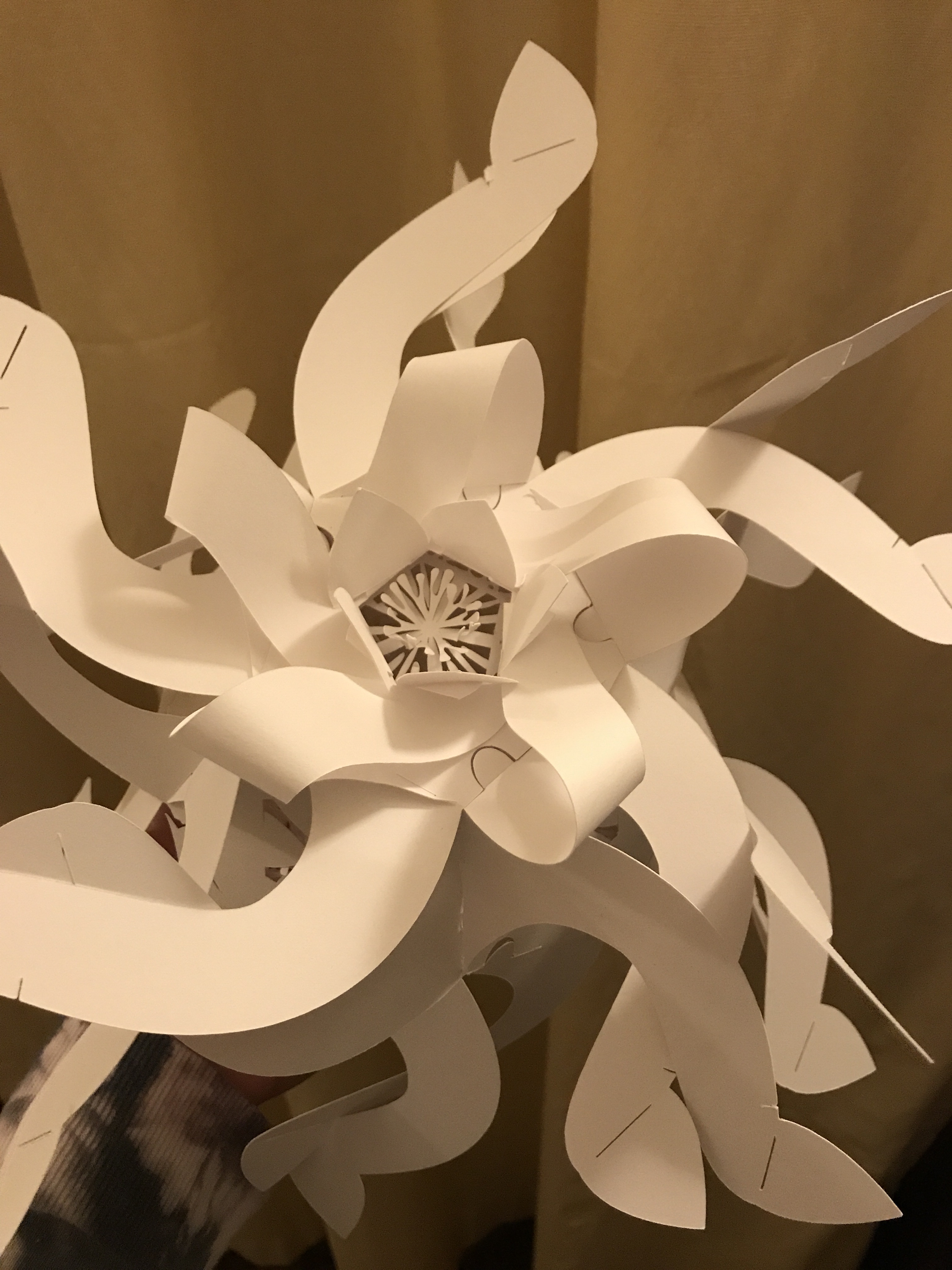
The lamp shown on this page employs two different layering effects. One uses cutouts that are laid behind the module to project a soft mottling pattern. The other makes the raised "stamen" that is bent three-dimensionally outward. At the bottom of this page is an image of the paper prototype, which did not contain all of the planes necessary for the finished lamp. In the prototype, the method of achieving the stamen effect is clear: it is actually a perforated surface - with the raised bits being made from the negative spaces left from the bent portions. Upon close examination, the stamen and the mottled pattern that projects from behind are one and the same extra layer.
In the finished lamp, the flower centers are very bright because of through-openings. The light that emanates from these openings is either what is reflected from the inside surface of the lamp, or comes directly from the bulb, depending upon site lines and view angle.
This lamp is Dynamic and Circumvolved. It also uses Interlocks. You can see the circumvolution slots in the ends of the extensions. These bend back and then up to form flower petals. Can you tell how the slots are utilized? They are camouflaged well, so it is not obvious how, but they seem to be connected to bent-away sections that originate from the "hole" in the module where the stamen is filling the hole. These bent-away tabs are made out of the material that make the hole.
One last detail to notice is that there is a small notch near the slots made in the ends of the extensions. They allow each petal to overlap their adjacent petal by just a little so everyting can fit together.