Lamp Project Introduction
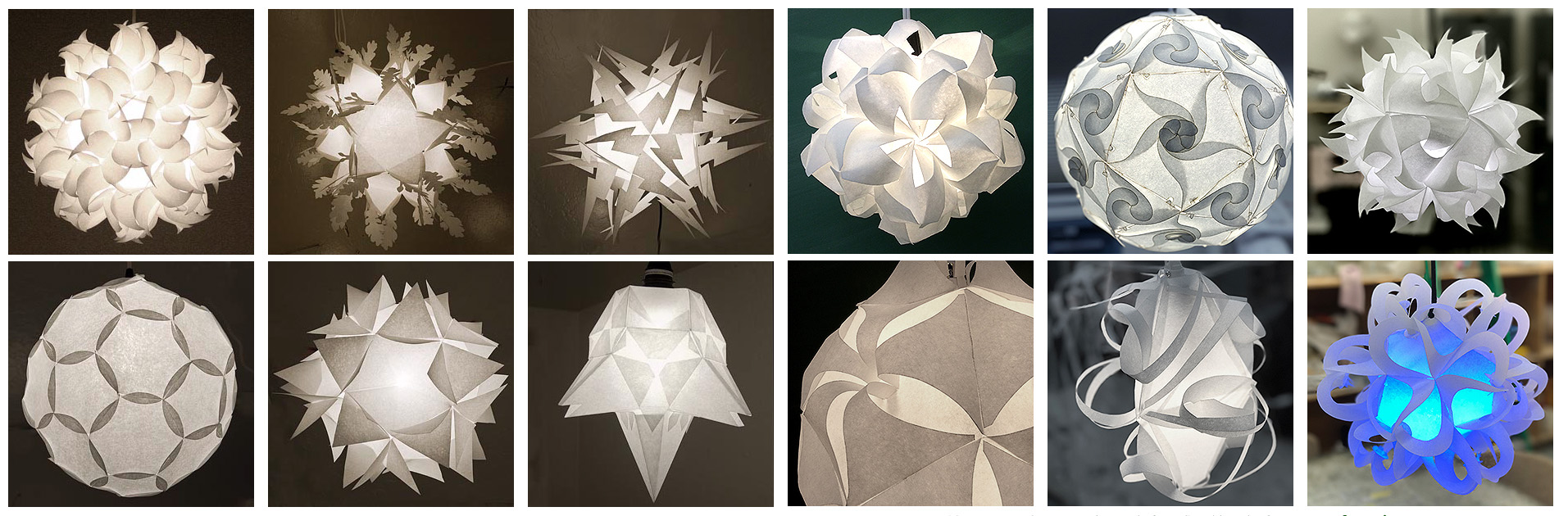
Above is a video of the first circumvolved lamp design. It was created in Spring 2014 by River Mortenson. She evoked the feeling of floating flowers by elongating the extensions to the point that they reconnected above the faces of a truncated regular octahedron. This video shows the relationship of the "floating part" to the core.
The Lamp Project is intended to utilize aspects of design that are naturally pleasing to the eye, such as pattern, repetition, and rhythm to create unity in the piece. Properties of light emission create unity as well by using contrast, shadow, tonality, and light fall-off. The lamp you design becomes a singular volumetric form that not only produces a pleasing light that can be looked at directly without eye strain, it creates an atmosphere to the room. The use of negative space within the extensions and around the perimeter further enhance the lamp's appeal.
Goal
Making a functional object like a lamp requires safety measures, material choices, construction techniques, and design considerations which may go beyond those of typical fine art projects. Electricity is a potentially dangerous phenomena which must be respected and understood. Also, lighting generates heat, so minimizing the risk of fire is of utmost importance. Finally, a functional object by definition serves a utilitarian purpose (in this case, providing useful light).
Aesthetics in this project begin as form following function, and is built upon from there. Make your design decisions on mechanical necessity augmented by visual dynamics. Look at elements in the underlying structures described in the links below. This will inform you of possible variations. Rely on the intrinsic symmetries of these forms to create new, more involved and complex designs. Developing a relationship between the underlying structure and your added extensions will make your project unique and alive.
- Platonic Solids
- Archimedean Solids
- Archimedean Duals
- uniform Polyhedra as they transform into their duals
The shapes of extensions can be geometric or organic. Directional movement can be achieved by leaning the shapes in regular ways. Chaotic or seemingly random interrelationships between the extensions can also be deliberately created. The original surfaces of the underlying form will be seen through the negative spaces between the extensions. Use this to create deeper patterns.
There usually are at least four unique vantage points from which you can see interesting relationships in your lamp. One is from flat-on to the face. Another is straight out from a vertex, another is from directly above the interlock of two extensions, and the last is from a non-aligned angle. Look at these views for analysis of your design.
All design work should be done through full-scale paper models. By working this way, it will be easy to re-design by tearing things apart, augmenting, and re-arranging. Feel free to tape, staple, glue, or simply paperclip sample units together to help speed up the design process.
My job: encouraging you to change your minds and change the form as you work.
Safety
- Lamps and lamp shades are made from many different materials and methods. They serve the purpose of efficiently transmitting electrical current into a light bulb while also protecting the user from electrical shock, heat buildup, and risk of fire. Flammable materials must either be chemically treated, or otherwise safeguarded from the bulb's heat.
- Using store-bought, UL approved, hanging socket sets and standing lamps help protect oneself from mishaps, as does the use of shade materials with natural flame resistance or those that are non-flammable.
- Follow all manufacturer's instructions in the safe use of their products.
- LEDs are preferred for producing light over fluorescent and incandescent because they use far less electricity, last longer, produce less heat, are not made from brittle glass, and unlike fluorescent, do not contain toxic materials. LEDs do produce some heat though.
More on safety is covered in: Electricity and Heat: Safety Design Considerations.
Rules
- Using simple tools and sheet materials, design and construct a hanging lamp.
- Study the Platonic Solids Links to an external site., Archimedean Solids Links to an external site.,and Archimedean Duals Links to an external site. as base elements for your design.
- If desired, expand these forms into TRUNCATED, STELLATED, or ANTI-STELLATED versions, regularly proportioned.
- The base element must not be a tetrahedron or a cube. These are too simple.
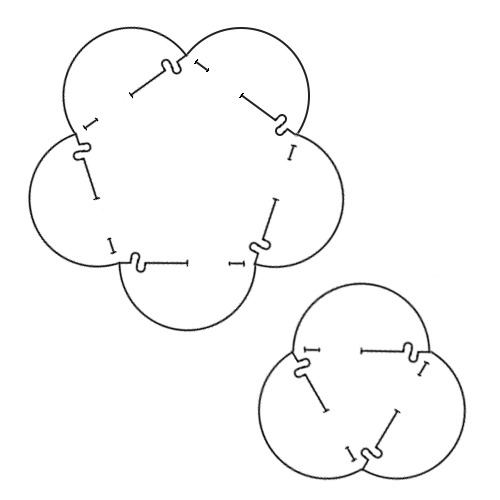
- Design an INTERLOCKING MODULE that will make up the face of your polyhedron. This interlocking module, when repeated accurately, will link together to form your lamp.
- This module will contain geometric, curvilinear, or freeform organic EXTENSIONS.
- These extensions obscure or camouflage the underlying volume, allowing elements of the volume to radiate higher light levels.
- Extensions can form CIRCUMVOLUTIONS, which reattach to itself, adjacent extensions or the underlying polygon.
- The resulting module, or unit, must be made from heat resistant material. This will be discussed at length on the Lamp Materials page.
- All pieces must be nested closely together to reduce waste.
- LED, or fluorescent bulbs, and cords with sockets may be provided by instructor. If not, you will be responsible for acquiring them.
- Assembly must be done without additional fasteners when possible.
- The internal volume should be completely closed, as well as an un-penetrated volume (in other words, if you look inside of the structure, it will look smooth and solid).
- Create a hole for the lamp socket, taking care to ensure structural integrity. The entire lamp should be assembled without any glue.
Exceptions to the Above Rules
- You may also design a lamp where the underside is open to allow for bright cast light. This would be useful for above a dining table. If you choose to create a design in this way, make sure that the raw bulb is not visible.
- It is possible to create a non-regular lamp, but if you do, you will still need to demonstrate an understanding of the modular design concepts.
- You may use a tetrahedron or cube as your base element ONLY if you can demonstrate that your design is complex and visually stunning, the light bulb will fit within it safely, and after receiving direct approval from the instructor.
The Butterfly Problem
A complex solution to the lamp problem is called the Butterfly Problem, named after a lamp created by a student who wanted to make their modular units with extensions that formed bilaterally symmetrical butterflies. This meant that the module needed to contain irregular extensions that met up with its mirror rather than its rotated self. Normally, repeating modules automatically meet up with their rotated selves rather than their mirror selves. Flipping a module over and reversing the interlock cuts could accommodate for a few interlocks, but cannot be sustained throughout the lamp. Instead, some butterflies will have genetic abnormalities. The butterfly problem can be successful utilizing a single module design, with a bit of ingenuity.
What is Due
Final lamp, made from heat resistant material, fully assembled, set up for presentation - either hanging, set on a table if designed for this, or integrated with a stand - and illuminated.
