Size Considerations
Volume Considerations
When deciding on the size of your finished lamp, certain issues must be considered, such as how the socket fits to the shade, how the socket or cord supports the shade, clearance from the shade to the bulb, how rigid the shade material is - can the shade material hold its form when hung from the socket? The "roundness" of dodecahedrons and icosahedrons allow for space around the bulb, even with small shades. On the other hand, a tetrahedron is not a good volume choice because it has so little "roundness", the shade would have to be very large to provide bulb clearance. Further, they are too simple to use for the lamp project. Other volumes may likewise have similar problems of simplicity or small volume.
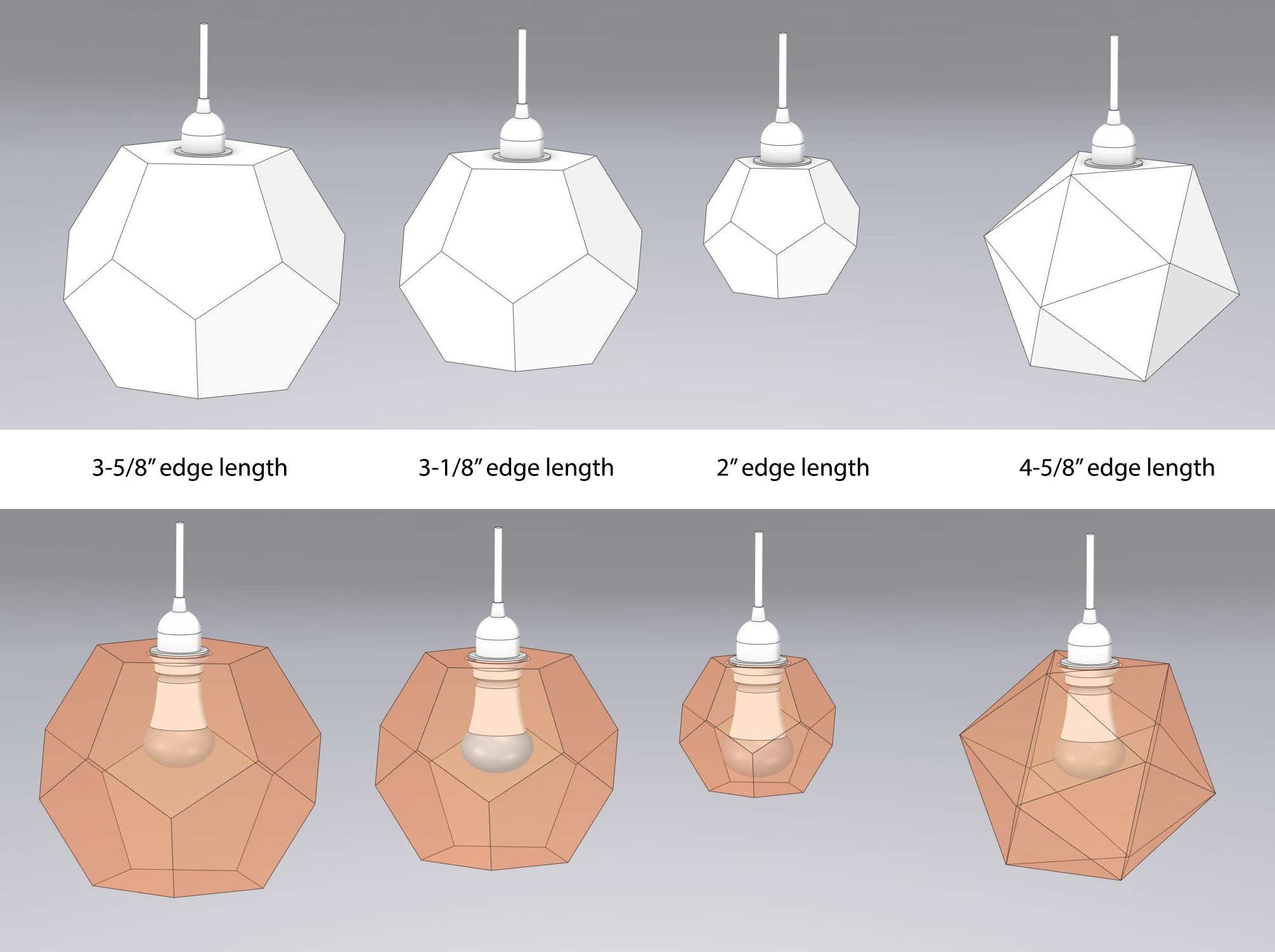
As illustrated, it is possible to make functioning enclosures in varying sizes that will still accommodate the bulb and socket. It is possible to make larger lamps, but the light will be dimmer, and the upper portion will be brighter than the lower portion. Larger lamps can also accommodate a brighter bulb to give the lamp its desired light level. Sometimes brighter bulbs are bigger in length and diameter. If there is a generic size to make a lamp, the module edge lengths can be 3-1/8" for a Dodecahedron, and 4-5/8" for an Icosahedron - these center a standard 60W equivalent LED bulb.
From a safety perspective, the shade must not touch the bulb ever. There must be a minimum clearance. With LEDs, the hottest part of the bulb is the stem where electronics are located. This gets much hotter than the globe. Please see more information on the Electricity and Heat: Safety Design Considerations page.
Light Fall Off
How bright do you want your lamp to look?
Light fall off is when light reduces brightness in an inverse square as it travels away from its source. For example, the light level at two inches away from the bulb is 1/4th as bright per square inch as it is at one inch away. Four inches away is 1/16th as bright. The bigger the shade area, the lower the surface brightness. Although there are just as many photons hitting a more distant shade, they are spread over a larger area. Still, though the same overall light reaches the larger shade, more light is lost because there is more shade material, meaning that there is more physically blocking the passage of light.
Conversely, a small shade looks brighter, and may in fact be too bright to look at for very long. For bigger shades, higher lumen bulbs can be used, if desired.
Socket Fit
Aesthetics and Scale
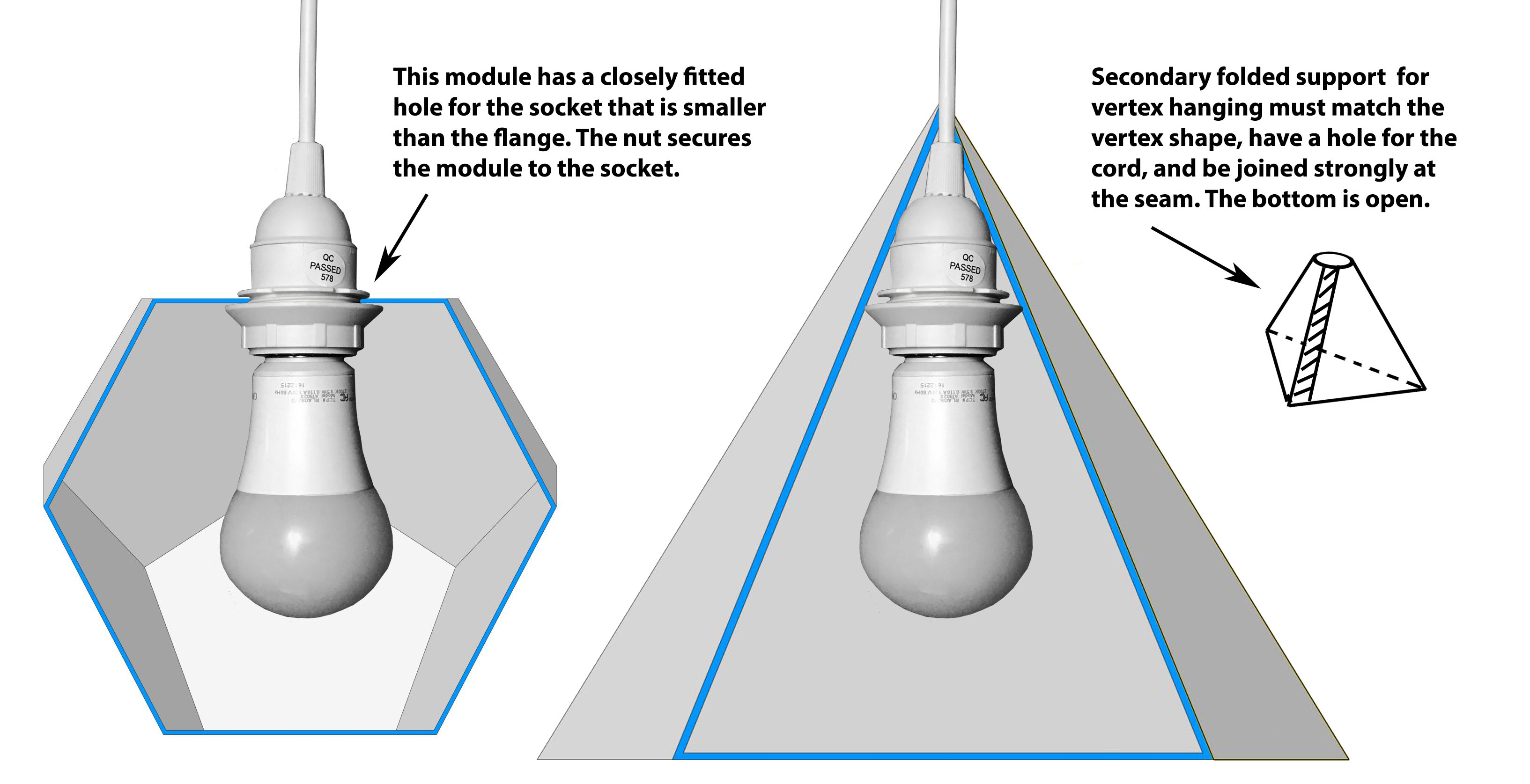
Aesthetically, when the bulb is not centered in the shade, it does not distribute light evenly. When the socket is not integrated well, the lamp looks sloppy. Fitting the socket means cutting the proper sized hole in a module. The hole must be large enough to fit over the threaded portion of the socket, but not as big as the flange, otherwise it will fall through. The nut then secures the shade to the socket.
If you wish to hang the lamp from a vertex rather than a plane, accommodation must be made to fit the cord up through the vertex by trimming enough of the vertex to provide the fitted opening. The cord must fit well. One common issue with this type of design is that the tabs pull open and the lamp falls off the bulb, since there is no flange to hold it in place. There are a couple ways to address this. The first is to add a secondary support inside the vertex, around the cord that the shade rests upon. This secondary support is a single, folded piece, stapled, glued, or interlocked together over the cord. For example, if you were to hang from the vertex of an icosahedron, five planes would meet there. In the drawing above, the cord passes through the vertex of a tetrahedron; thus the tetrahedral support. This is a strong way to support the corner, but it does interfere with the luminosity , and will be visible when the light is on.
The second method is to sew the corner shut with a clear monofilament like fishing line. This can be more subtle than the secondary support, or it can look really messy, depending on your sewing skills. It disrupts the light less, but regardless of the method you use to secure the vertex, since the entire socket is within the lamp, the light distribution tends to be uneven in this sort of design and must be a consideration as you're working on your prototypes.
Black or colored threads can also be used as long as the aesthetics are considered. It is possible to make this thread a strong part of the design with elaborate knots or long strands. It must work well from a visual design point of view if done this way.
Another aesthetic decision on size is how the lamp will fit in its final location. Consider the site. Is the ceiling high up, or only 8'? Is the room large or small? Does the lamp hang in a corner above an end table? Is it hung over a dining table? How bright is the room already? These factors should be taken into account if you are building for a specific location and purpose. On the other hand, if you have no requirements for a site-specific piece, then build to the minimum size for safety.
Cost and Materials
Materials cost money and use resources. The larger the lamp, the more material and expense it will take. Theoretically, it should take twice as long to cut out pieces that are twice the dimensions. Even though the area is four times as big, the perimeter is twice as big. It would cost 4 times the amount in materials but only take twice the amount of time to make.
Structural Considerations
Can your material handle the scale of your lamp? Lamps that are tiny make the modules feel stiff and difficult to assemble. Large lamps make the modules feel thin, floppy, and fragile. There are different thicknesses and qualities to shade material options, which must account for scale. A lamp shade that is really large will collapse due to its own weight, will distort, and may even tear apart at the interlocks. If a very large shade volume is desired, there may be need for other structural components to be added to the design to carry the load.
