Standing Lamp by Karen Smith
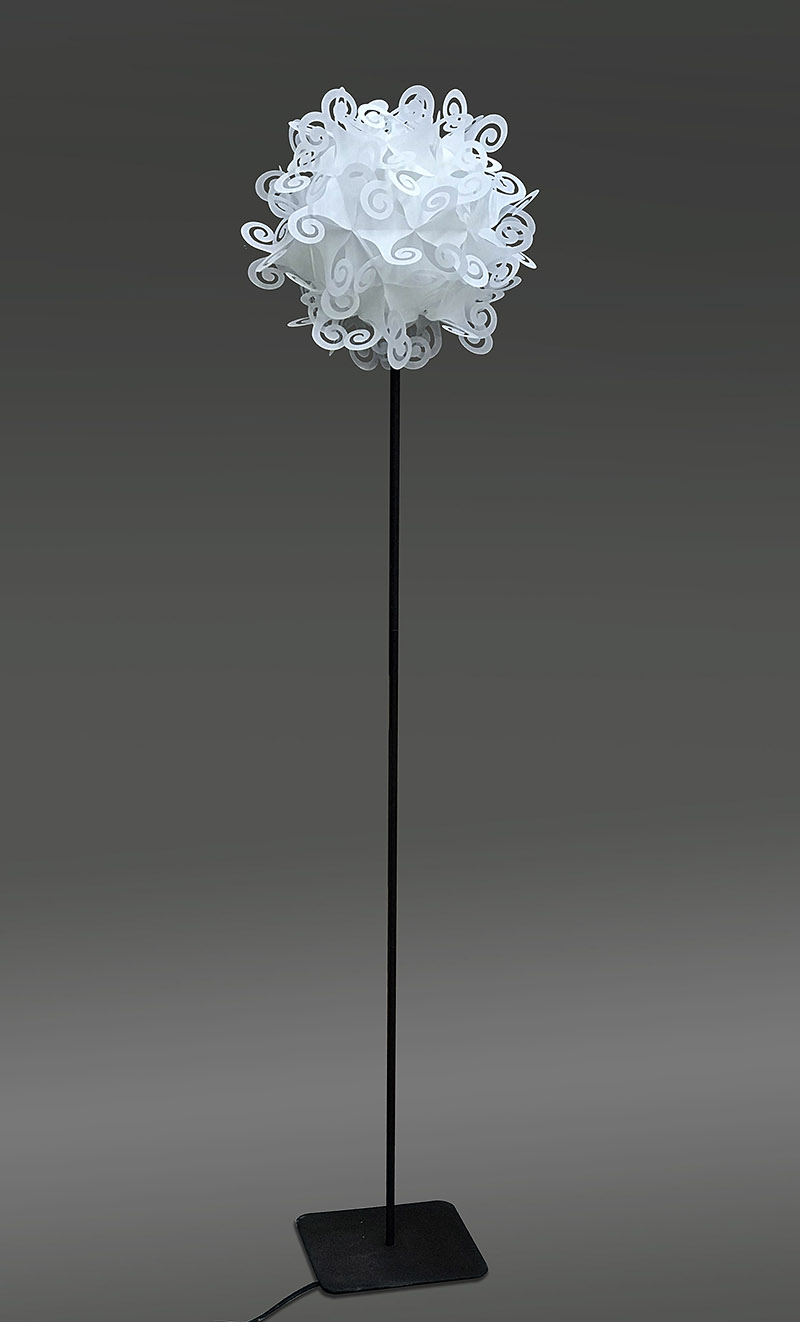
You can see this image larger in a new window by clicking in Enlarge. Then use the "back button" to return to this page.
Besides hanging, your lamp can also be integrated into a variety of appropriate bases that you acquire for yourself. For her piece, Karen Smith utilized a floor stand purchased from Ikea. Normally in this project, the lamp hangs by its own weight from the flange of a swag kit hooked to the ceiling, but in this design the shade has to be self supporting from below.
For Karen's lamp, a plate had to be created that allowed one of the modules to rest flat on it. Here, a pentagon was made from either 1/8" or 1/4" clear acrylic sheet. A hole large enough to slip over and fit snugly against the lamp socket had to be made in the acrylic and the module. A second sheet could have also been added to sandwich the module, securing it in place.
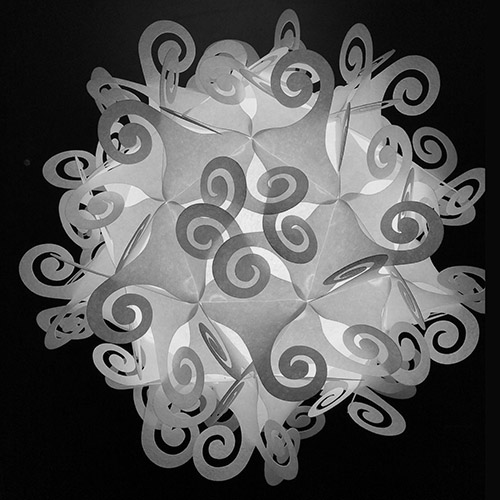
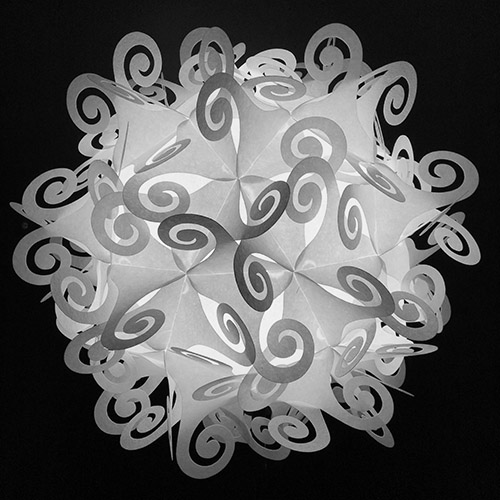
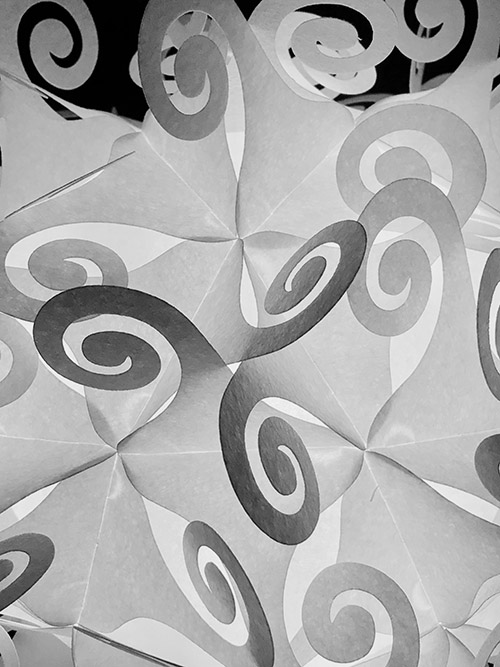
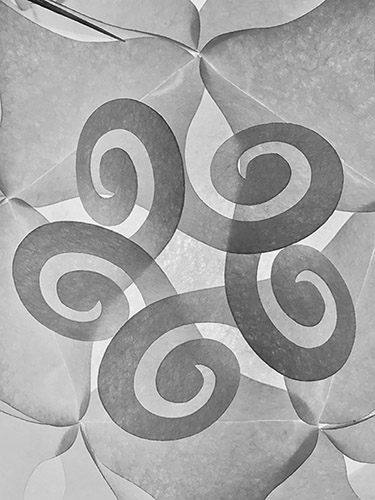
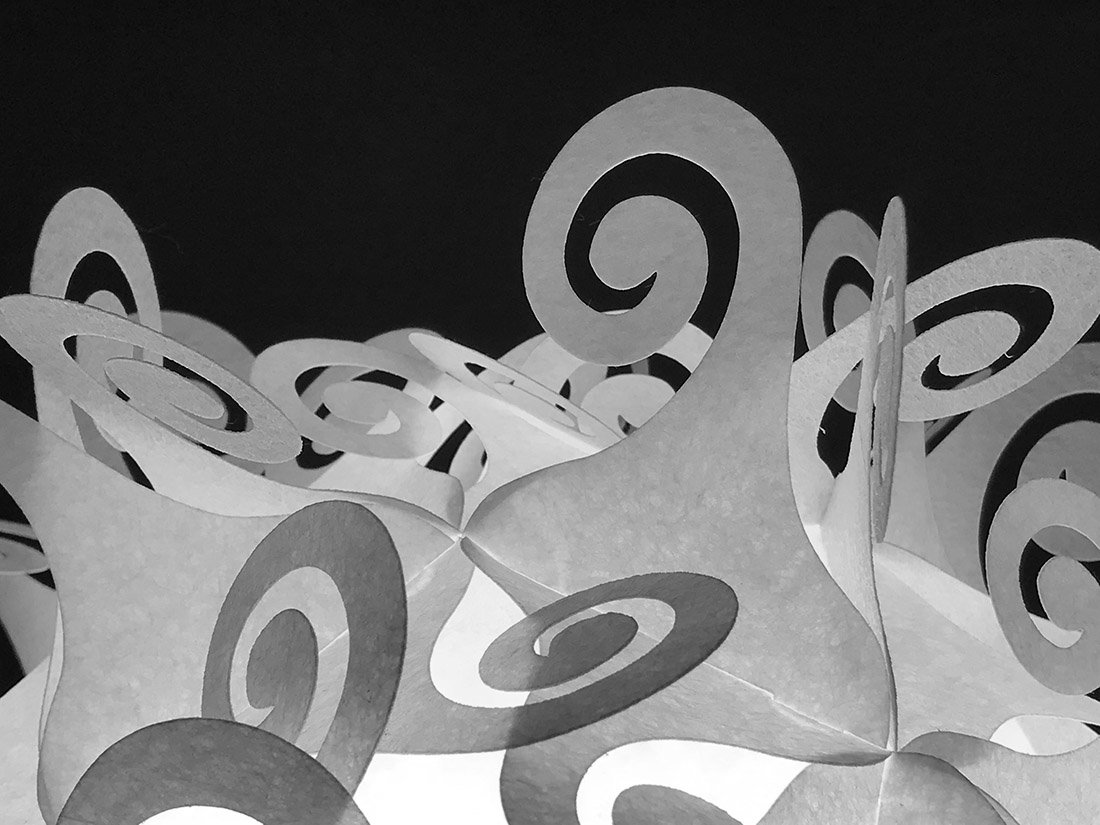
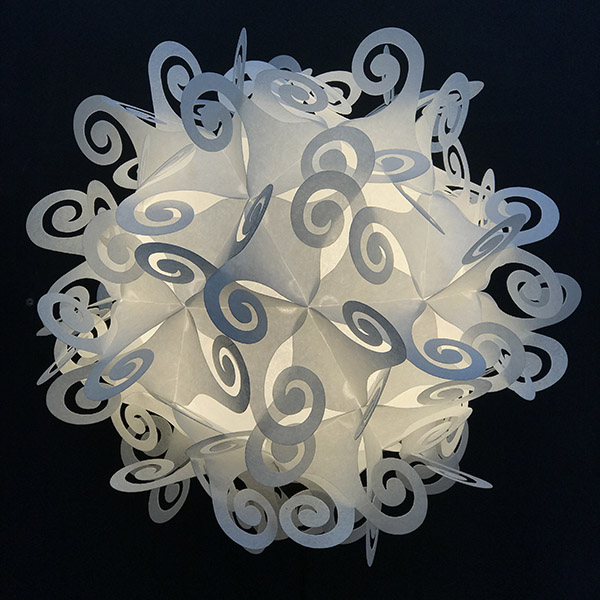
Karen's beautiful design was cut-out using a Cricut Maker machine. After paper prototyping, she drew the modules in Adobe Illustrator creating vectors to get the precise forms: a pentagonal module, a triangular module, and pentagonal module with a hole in it for the socket. The detailed images on this page show the patterns created over the pentagons and triangles, a view from the edge, and the lamp tips illuminated with cool daylight coming from a window.
The spirals with rounded tips would have been tedious to cut out by hand, especially because they are continuous curves. Using the Cricut still took plenty of time, but the cuts were very clean. There is a substitution in skills from hand cutting to computer technology, and neither is better, unless cost is a factor because tech is expensive, or if a high level of production is necessary, in which case CNC cutting or die cutting would be the only possibility. Before deciding to use laser cutters or Cricut cutters, you must first develop your hand skills. This is true in nearly every field of expertise. An architect should practice construction before they are allowed to design a structure.
Karen employed a truncated dodecahedron to create her lamp, meaning it is made from 12 pentagonal and 20 triangular modules. All of the swirling extensions are identical, thus where they overlap the triangles, the triangles are completely obscured, and where they overlap the pentagons, there are windows into the core volume.
The photographs, below, show the various symmetries present in this lamp.