TETRAHEDRON - Drawing a Pattern
10 minute video on drawing a tetrahedron pattern.
The above video describes the process of drawing a tetrahedron pattern. It does not show assembly. A tetrahedron is composed of four equilateral triangles in a row. There is no need to draw any perpendicular lines, so the process is quick and easy. The compass is set only one time.
Demonstrated in sketching is a process of visualizing how the pattern forms into a tetrahedron.
Notice that at no point was a ruler used, nor any numerical measurement made.
The tools used are:
- straight edge
- pencil
- eraser
- compass
How a Tetrahedron Pattern is Derived and Tabbed
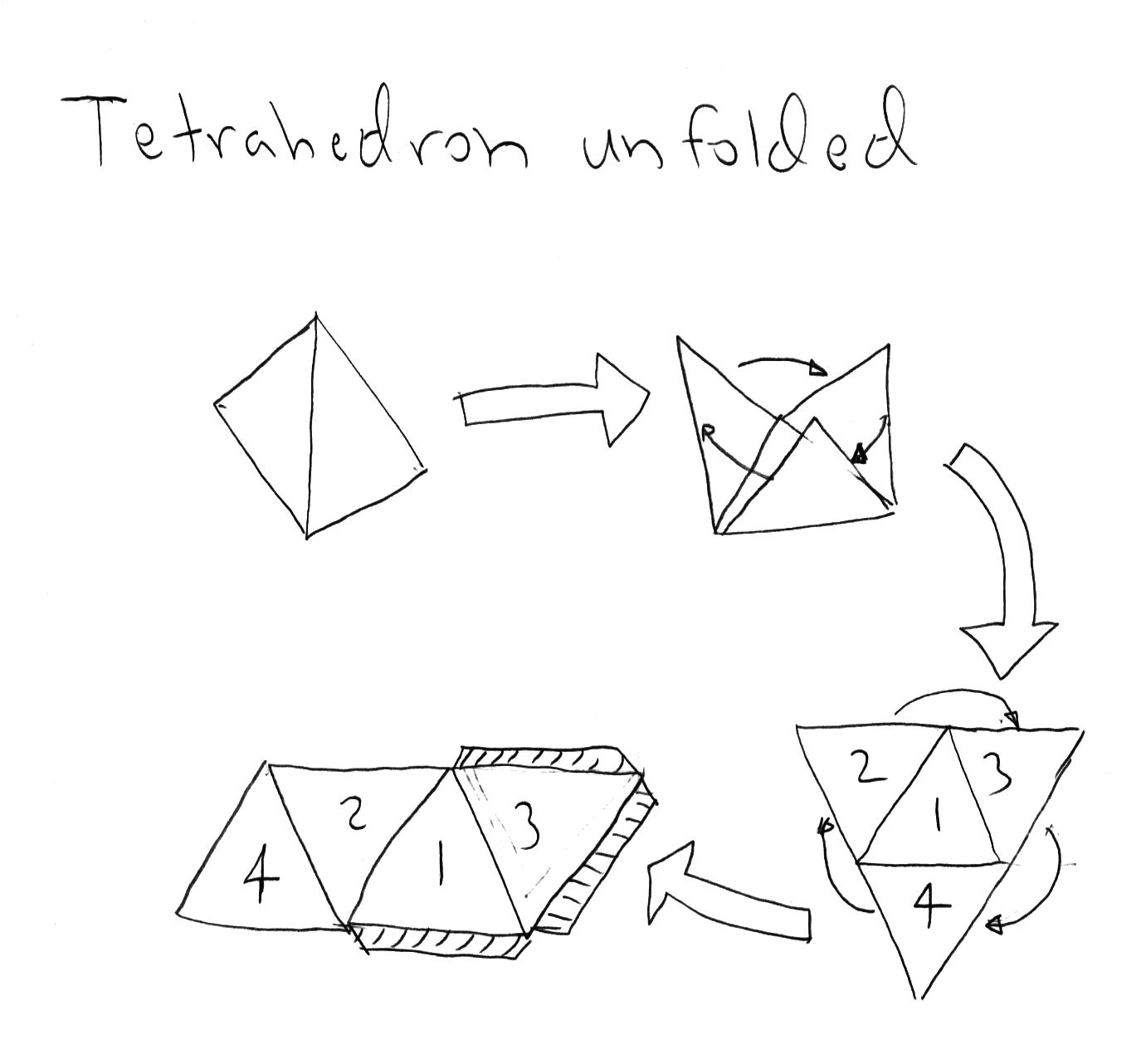
Reverse engineering the Tetrahedron can be done in several ways, but visualizing it opening like a flower lays the pattern out as a large equilateral triangle divided up into four smaller equilateral triangles. However, this pattern is difficult to assemble due to the fact that all seams go to one peak. An alternalte pattern is when the triangles are rearranged so that they are in a row. This row pattern is achieved by moving various traingels to attach at other logical edges (where they would attach anyway as the pattern is assembled).
Tab placement must be thought out so that only one tab is created for each glue seam. Because all angles in an equilateral triangle are 60 degrees, care must be taken to pitch the ends of the tabs to 60 degrees or less so that they tuck into the form without interference.
