Basic Polyhedra
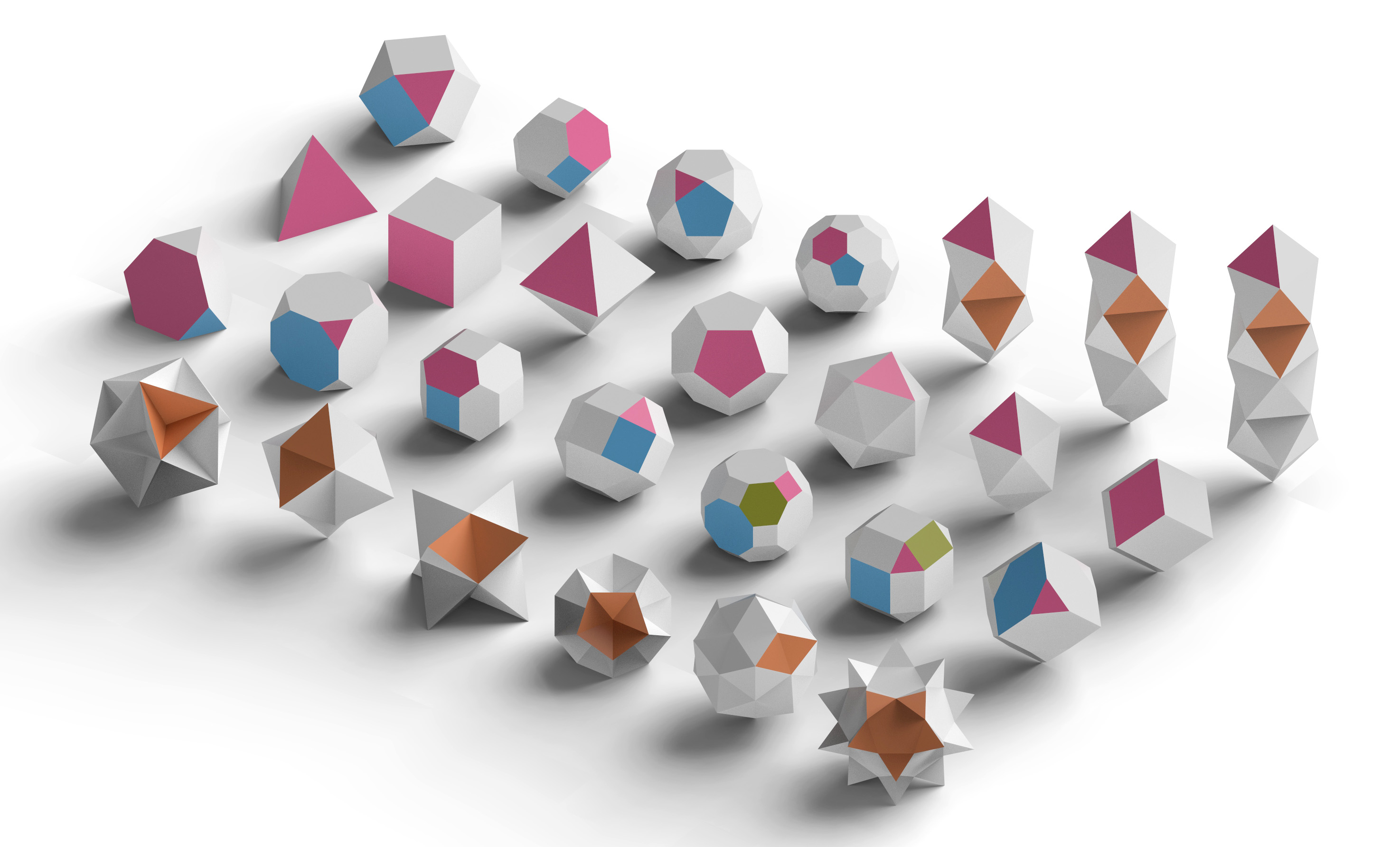
The volumes shown above fit into these five categories:
- Seven polyhedra, shown in the second row from the back, use repeats of just one type of polygon. All but one contain regular polygons. The last is not regular, and contains a specific pattern, described later on this page. (raspberry/white)
- Nine polyhedra contain two polygons each. Four are in the back row, starting on the left, and five more are scattered throughout the second row. Seven of the nine are made solely from regular polygons, and two have one regular and one irregular polygon each. (raspberry/blue/white)
- Two polyhedra in the second row contain three types of regular polygons each. (raspberry/blue/green/white)
- The six polyhedra in the first row are each made from single module designs that repeat, but what makes them unique is that each polygon is complex, and creased at their concave dihedral angles. Two are made from patterns that have glued tabs, which form anti-stellations. Five of the polyhedra, except for the one on the left, are made entirely of regular polygons sharing fold lines. The left polyhedron employs 45° right triangles, but they don't need to be so to work. (orange/white)
- The final three polyhedra, in the back row, right, are made from equilateral triangles, but the orange modules are composed of two joined triangles, creased in the middle; whereas the raspberry module is a single triangle. (raspberry/orange/white)
Details
In relation to the Lamp Project, the Basic Volume is what creates a safe enclosure for the bulb, centers the bulb for even light distribution, and also forms the structure upon which extensions are designed. It is a polyhedron because it is made of polygons that meet at edges and vertices.
One Regular Polygonal Module
Regular Platonic polyhedra are one choice for lamps because their regular polygons are simple to draw, and each module is identical. As mentioned, only dodecahedrons and icosahedrons are acceptable because the others are too simple.
Two Or More Regular Polygonal Modules
Archimedean solids, Johnson solids, or other regular polyhedra are also excellent choices. There may be two or more different styles of modules. In some cases, this is beneficial for the Butterfly Problem when the polyhedron is made from two distinct polygons that is laid out so that now two alike modules join edges. This is the case with the icosadodecahedron: all triangle edges only touch pentagons, and all pentagonal edges only touch triangles.
Irregular, Creased, Glued Polygonal Modules
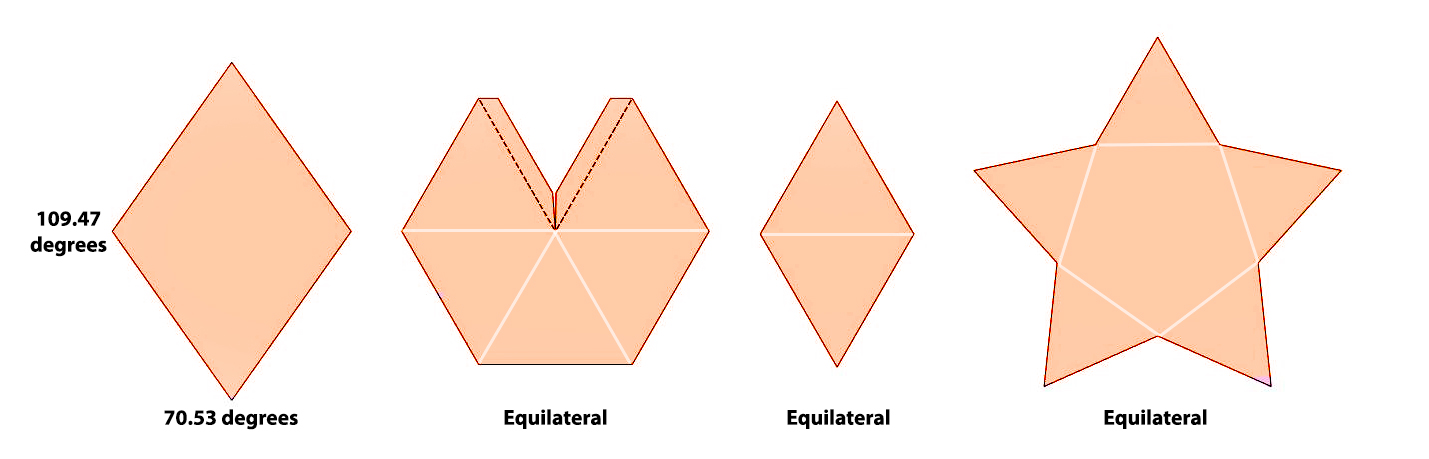
Stellated and anti-stellated polyhedra can also be employed, as seen in the image at the top of this page. When there are concave dihedral angles, simplify the modules by combining polygons and allowing for creases during assembly. Then the extensions only become necessary at convex dihedral angles. Further, you avoid having extensions face inwards, interfering with the light bulb.
In general, your basic volume must be clean and fully enclosed, made from planar material. Poorly fitted parts make the lamp feel messy, unrefined, and damaged.
Lastly, it is possible to make lamps from curved volumes, but this challenge requires your own research and testing, and also approval from the instructor.
More information for those interested:
For those who are statistics-minded, here is a list of various polyhedra, listing polygon information, extension quantities, and other data:
- Tetrahedron
-
- 4 equilateral triangles
-
- 4 vertices
-
- 6 dihedral angles
-
- 3 extensions per triangle
-
- 12 extensions overall
-
- Because there are only four modules, and the angles are very sharp, it is too simple for most lamps.
- Cube (dual of the octahedron)
-
- 6 perfect squares
-
- 8 vertices
-
- 12 dihedral angles
-
- 4 extensions per square
-
- 24 extensions overall
-
- Because there are only 6 modules and 90° angles, it is too simple for most lamps.
- Octahedron (dual of the cube)
-
- 8 equilateral triangles
-
- 6 vertices
-
- 12 dihedral angles
-
- 3 extensions per triangle
-
- 24 extensions overall
-
- Although there are 8 modules, it is too simple for many but the most clever lamps.
- Dodecahedron (dual of the icosahedron)
-
- 12 regular pentagons
-
- 20 vertices
-
- 30 dihedral angles
-
- 5 extensions per pentagon
-
- 60 extensions overall
-
- 12 modules make for a good lamp.
- Icosahedron (dual of the dodecahedron)
-
- 20 equilateral triangles
-
- 12 vertices
-
- 30 dihedral angles
-
- 3 extensions per triangle
-
- 60 extensions overall
-
- 20 modules make for a good lamp.
- Truncated Tetrahedron
-
- 4 hexagons
-
- 4 triangles
-
- 12 vertices
-
- 18 dihedral angles (6 of one angle and 12 of another)
-
- 3 extensions per triangle and 4 extensions per square
-
- 36 extensions overall
-
- Because there are only 8 modules, this may be too simple for most lamps.
- Cuboctahedron
-
- 8 equilateral triangles
-
- 6 perfect squares
-
- 12 vertices
-
- 24 dihedral angles
-
- 3 extensions per triangle and 4 extensions per square
-
- 48 extensions overall
-
- 14 modules of two types makes for a good lamp.
- Rhombicuboctahedron
-
- 8 equilateral triangles
-
- 18 perfect squares
-
- 48 dihedral angles (24 of one type, and 24 of another)
-
- 3 extensions per triangle and 4 extensions per square
-
- 96 extensions overall
-
- 26 modules of two types makes for a good lamp.
