Pattern Development
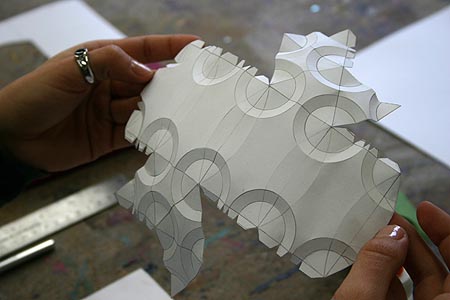
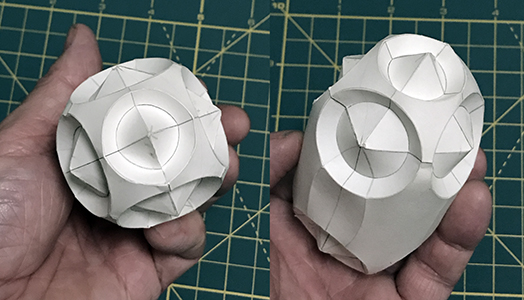
Over the course of this project you are going to be developing flat patterns made from polygons and other flat shapes. Patterns are essentially 2D plans of what you are going to make into 3D volumes. They are flattened pelts of the little paper beasties you are creating. You will learn how to accurately draw various polygons, how to consider relationships between these forms, and how to fold a pattern into a polyhedron. When developing patterns, you will gain skills in visualizing 2D patterns as 3D forms.
Accuracy
It is critical early on that you learn how to draw clean, thin, erasable, and visible lines. These lines need to be accurately positioned so that the shapes you draw come out as intended. You will need to learn how to place a pencil point right where you want it, align a straight edge precisely, and how to make measured, repeatable markings. Tools necessary for the process include:
Sharp Pencil Straight Edge or Ruler Story Pole Compass Eraser TGF relatively precise pattern, image 2, smaller.jpg
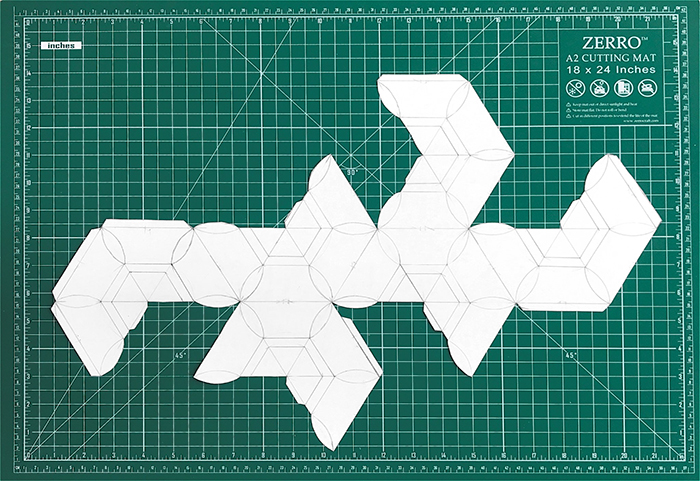
Patterns that are accurately drawn fit together more easily, make more sense as you try to figure them out, can be cut more easily, and glue up more neatly. A really accurately drawn and assembled form can look so refined that it is difficulty to tell that it is glued up or even has seams.
Drawing Perpendicular Lines
Also at the outset, you will need to master how to draw perpendicular lines using a straight edge and a compass. There are two methods that you will be taught:
Finding A Perpendicular Line On A Given Point
Bisecting A Given Line Segment
Both of these methods are simple once you master them, they will serve you well throughout the project. If you do not master them, your pattern development may suffer. For more detailed videos on how to draw perpendicular lines and bisect with your compass, see the All About Compasses page.
Neatness
Patterns should be as clean and crisp as you can achieve. Patterns that are messy or inaccurate make messy and inaccurate volumetric forms. An important component of the project is neatness and precision. The reason for this requirement is that it will help you become more dexterous, observant, and professional. From an aesthetic point of view, neat, clean and precise forms look more amazing and awe-inspiring. Below is an example of a relatively messy pattern, which makes it confusing.
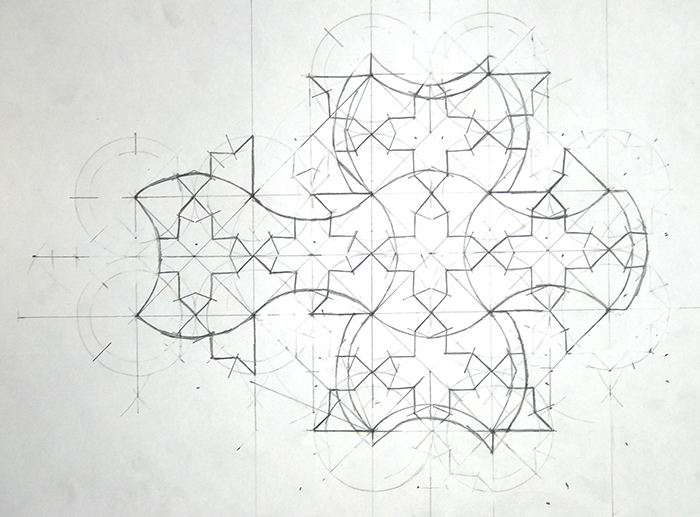
The complexity of what is being developed in the above example required lots of marks and lines to work it out. These layout lines are important, but should be drawn with a light hand so that erasing can be easier. It is possible to draw clean, thin, and light lines that will erase without a trace. The line thickness and relative imprecision will make cutting and fitting more difficult. On the other hand, it is an amazing design, and as a piece of art independent of the task, it is beautiful.
Glue Tabs
As patterns are developed you will have to understand which edges mate when assembled. As a general rule, for every two mating edges, there is one glue tab. You will need to visualize where an edge will end up, determine which of the two mating edges should have a glue tab attached to it, and draw the tab in place.
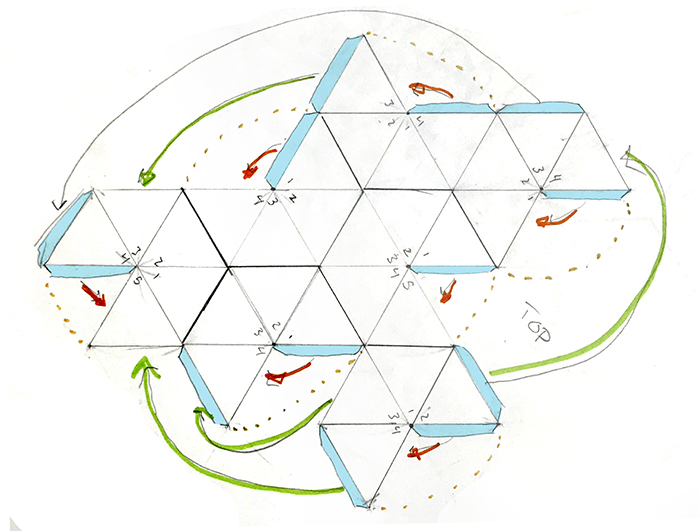
The blue in this photo represents the tabs, which are attached to specific polyhedrons. The red arrows indicate where tab connections exist within each stellation. Green arrows indicate where tabs connect between one stellation and another. The dotted lines indicate were vertices form when those corners are connected.
Make sure all patterns have enough room on the paper to accommodate glue tabs. Glue tabs need to be small enough to not interfere with the assembly process, and big enough that they are easy to keep in shape and to glue. A good width range is 1/4" to 3/8" or 5mm to 10mm.
The ends of tabs should be trimmed at an angle so that assembling and fitting is easier. They should go all the way to the corners, but taper as they move away from the edge of the polyhedron they are attached to.
They can be bigger or smaller as special needs are met.
Labeling
When a pattern becomes very complicated it is helpful to label the parts into recognizable groupings and to distinguish glue tabs from sides, such as with scalloping and notching. With scalloping and notching, the tabs are specially shaped to match the scalloped or notched faces to ease assembly and gluing.
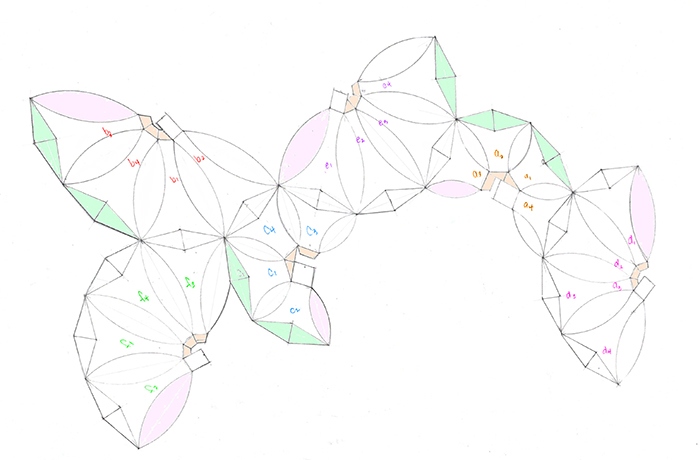
The image above is of a pattern that without the labels would be very difficult to follow. Color coding is helpful, as is alpha-numeric labeling (F1, F2, F3, F4, etc.) These labels help when assembling because it becomes clearer how to go about the assembly process; in this case, putting together the major forms first, then connecting the tabs to sides that link between the major groups.
Size
Patterns are drawn on flat sheets of paper. It is not essential that a pattern be made from a single sheet of paper, though this is a satisfying problem to solve. If you are to make patterns that fit on a single sheet, you will need to think this through before beginning the pattern; will it fit on a single sheet, or do I need to make it a little smaller to fit?
Reasonable dimensions for TGF is something that is not so small or large that it becomes a problem to assemble. There are other considerations as well. How much paper do you want to dedicate to a form? Also, when you make a very small form, the paper thickness becomes an issue; it becomes clunky and bulky at glue tabs. Tiny forms need to be more precise from the outset, and you have to take into account allowances for creases and overlaps, as these details are exaggerated in miniature. Think of a tiny doll wearing tiny clothing made from normal fabrics. The clothing will look stiff and bulky.
On the other hand, forms that are too big suffer in other ways. The surfaces tend to sag or collapse under their own weight. They are more easily damaged, more difficult to display, and more time-consuming to make. Larger patterns require more material resources, larger capacity tools, and more space to lay them out.
Choose a scale that is comfortable to you. Typical TGF forms are in the range of 2" - 4" across. They can be smaller or bigger as you see fit. Here are some example sizes:
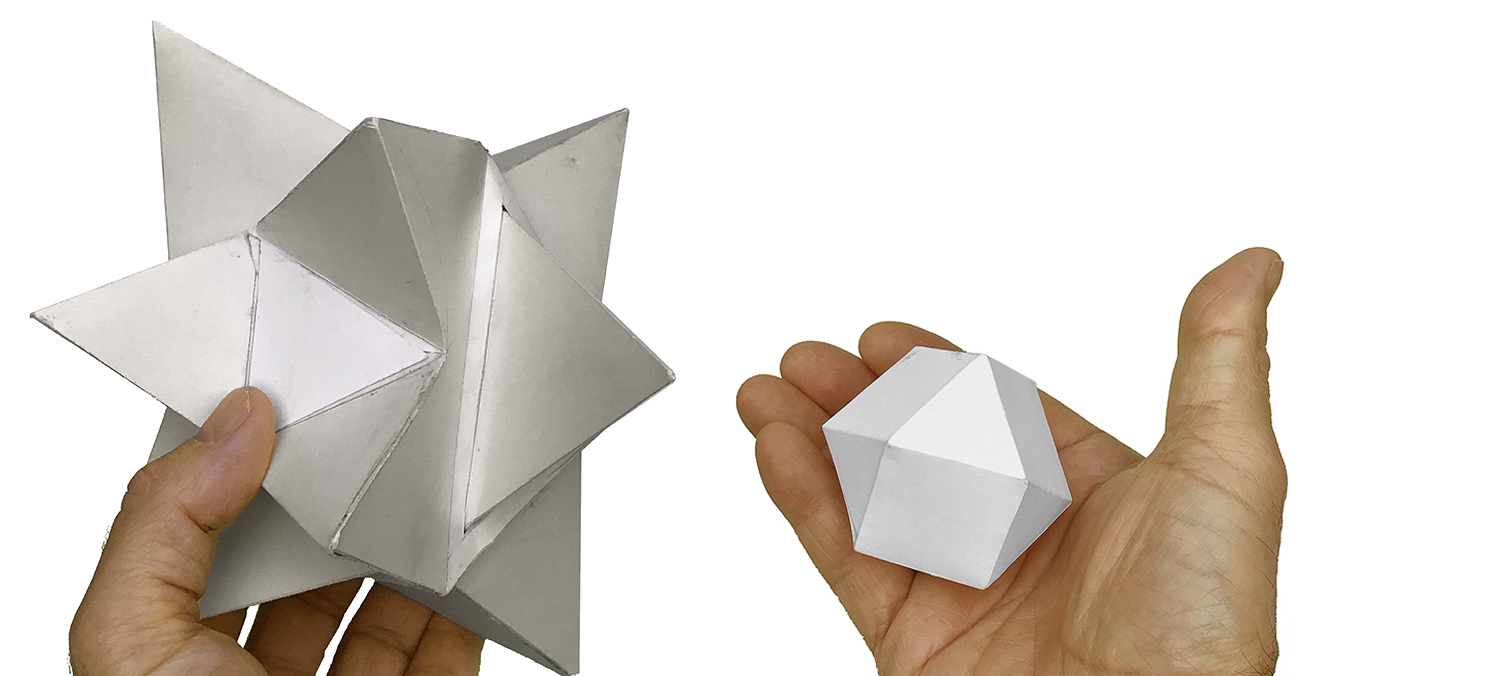
It is worth noting the messiness of the form on the left and the cleanliness of the one on the right. The messy piece could have come out cleaner by simply being less heavy with pencil, by erasing smudges before glue-up, and by keeping fingers and the work area clean.


